What Is STEM? - Definition & Resources for Teachers
STEM might win the laurels for the most talked nigh education buzzword of the last ten years or so. Information technology'south gotten to the indicate where, similar to the organic and low fat labels in the food manufacture, Stalk could mean very footling if you encounter it on toys or educational products. Then how practise we talk intelligently nigh STEM pedagogy and where it needs to go? The start step is agreement the history of this term and what it ways for schools.
What is STEM?
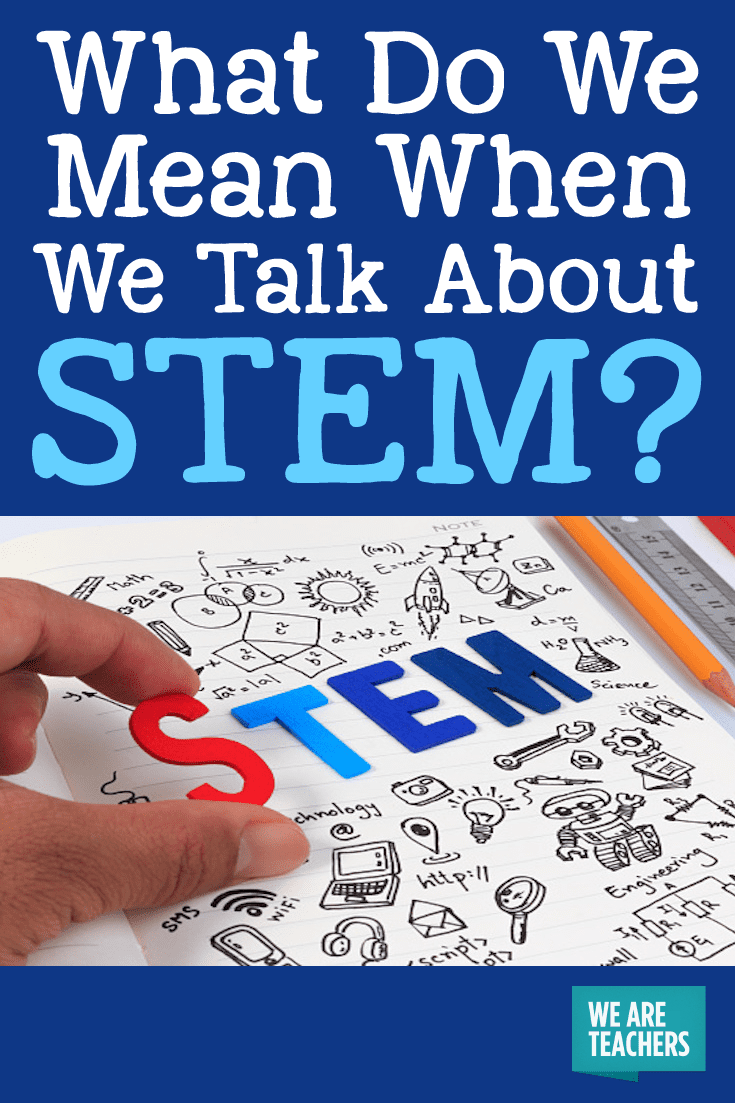
STEM stands for science , applied science , engineering , and math . Stalk curriculum blends those subjects in order to teach "21st-century skills," or tools students need to have if they wish to succeed in the workplace of the "hereafter." The idea is that in order to exist prepared for jobs and compete with students from different parts of the world, students here in the US need to be able to solve issues, detect and use evidence, collaborate on projects, and recollect critically. Skills, the thinking goes, that are taught in those subjects.
Still, Stalk can be hard to ascertain. It'southward such a popular term that information technology ways a lot of different things to a lot of dissimilar people. Although the science (biology, chemical science, etc.) and math (algebra, calculus, etc.) parts of the abbreviation might be piece of cake to figure out, the technology and engineering parts might be less clear. Applied science includes topics such every bit reckoner programming, analytics, and design. Technology tin can include topics like electronics, robots, and civil engineering. The key term, when talking well-nigh STEM, is integration . Stem curriculum intentionally melds these disciplines. Information technology'due south a blended approach that encourages hands-on experience and gives students the adventure to proceeds and apply relevant, "real-world" knowledge in the classroom.
Education buzzwords and the politicians who beloved them.
Like nigh things, STEM was effectually before it had an actual name. But Stem wasn't known as STEM until Dr. Judith Ramalay coined the term. While working as director at the National Science Foundation in the early 2000s, Ramalay came up with the term to draw the blended curriculum she and her squad were developing. Referred to equally SMET at first, which, if we had to guess, might also be the name of a Scandinavian dessert, Ramalay changed the acronym around considering she didn't like how SMET sounded. Then we (thankfully) got STEM.
STEM grew in popularity due to the concerns of politicians and other leaders that US students were not keeping pace with other students and would thus not be prepared to work in the fastest-growing career sectors, which generally autumn nether the STEM umbrella. In 2009, the Obama administration announced its plan to back up Stalk curriculum that would both encourage and train students to pursue careers in those fields. It would as well support teachers to, well, teach students those skills. That effort has been formalized in many ways, including using the language of Stalk in Next Gen Scientific discipline Standards . And so, teachers everywhere are expected—by parents, administrators, etc.—to provide a Stem-rich curriculum.
How do I "Stalk" my classroom?
We get it. Stalk sounds similar a lot. At that place's a big divergence between teaching students to recollect to deport the one and teaching them how to code. Merely there are elementary, unintimidating, and effective means to implement a Stem curriculum in your classroom that has cypher to do with teaching R2D2 to dab.
If you teach younger students, create an environment that encourages observation and asking questions that begin with Why … ? or How does … ? Go along nature walks. Sing "Old MacDonald Had a Subcontract" and use it as a springboard to think about the ecosystem of a farm. Explore how simple classroom machines, similar a stapler, work. Above all, it's important to help students to become a solid foundation. Make sure they are fluent in bones skills like addition and subtraction, measurement, or identifying shapes.
For upper elementary and middle school students, consider project-based learning. Pose problems that students can chronicle to, tin can exist solved in different ways, and let students work together and provide evidence of their thinking. Nigh importantly, students demand to be able to pull from their knowledge of different subjects every bit they work toward an answer. The Clan for Middle Schoolhouse Education, for example, provides several nifty scenarios that promote STEM learning. For instance, if there was an outbreak of illness at a carnival, how would your students solve that problem? Or, even more broadly, how might they create a community of the future?
Loftier school students, especially juniors or seniors, should definitely be thinking about higher and beyond. Exercise you take a student or 2 who might make a great crime scene investigator? How might you bring a version of the board game Inkling into the classroom? Help students utilize forensic scientific discipline and their investigative skills to determine whodunit and the crusade of death. What math skills practice they need to know to come up with the analytics to predict the next NBA champion? Or, take students run analytics for previous seasons and compare their results to what really happened.
But I teach English. What gives?
At that place'due south no I in squad . At that place'south also no A in Stalk—until recently. Asking questions, using evidence, and working well with others to solve bug are not skills taught merely in the "hard" sciences. Excellent humanities and social scientific discipline curricula teach these tools every bit well. And they engage students' creativity and imagination. Equally such, at that place's a growing move to incorporate more arts and humanities subjects into Stalk curriculum. This is a great co-teaching opportunity. How might your English class join up with science students in the previously mentioned Clue scenario? Maybe they tin write a backstory. Maybe another group of students can design and build a scale version of the crime scene. There are lots of possibilities. Above all, whether it'south Stem or STEAM, your program should encourage cross-curricular activities and inspire students to use and gain cognition in exciting means.
Need lesson plans and ideas? No problem.
WeAreTeachers has some excellent Stem and STEAM resources. Check out some of them:
- Hands-on Stem activities
- Post-test day Stalk activities
- Stalk activities with stuffed animals
- Taking Stem to STEAM
How exercise yous "STEM" your curriculum? Come share in our WeAreTeachers HELPLINE grouping on Facebook.
Source: https://www.weareteachers.com/what-is-stem/
0 Response to "What Is STEM? - Definition & Resources for Teachers"
Postar um comentário